How a team roping run is judged
Two riders, one steer, and a clock that will not stop until both horses are facing it. The rulebook is where this sport gets genuinely strange.
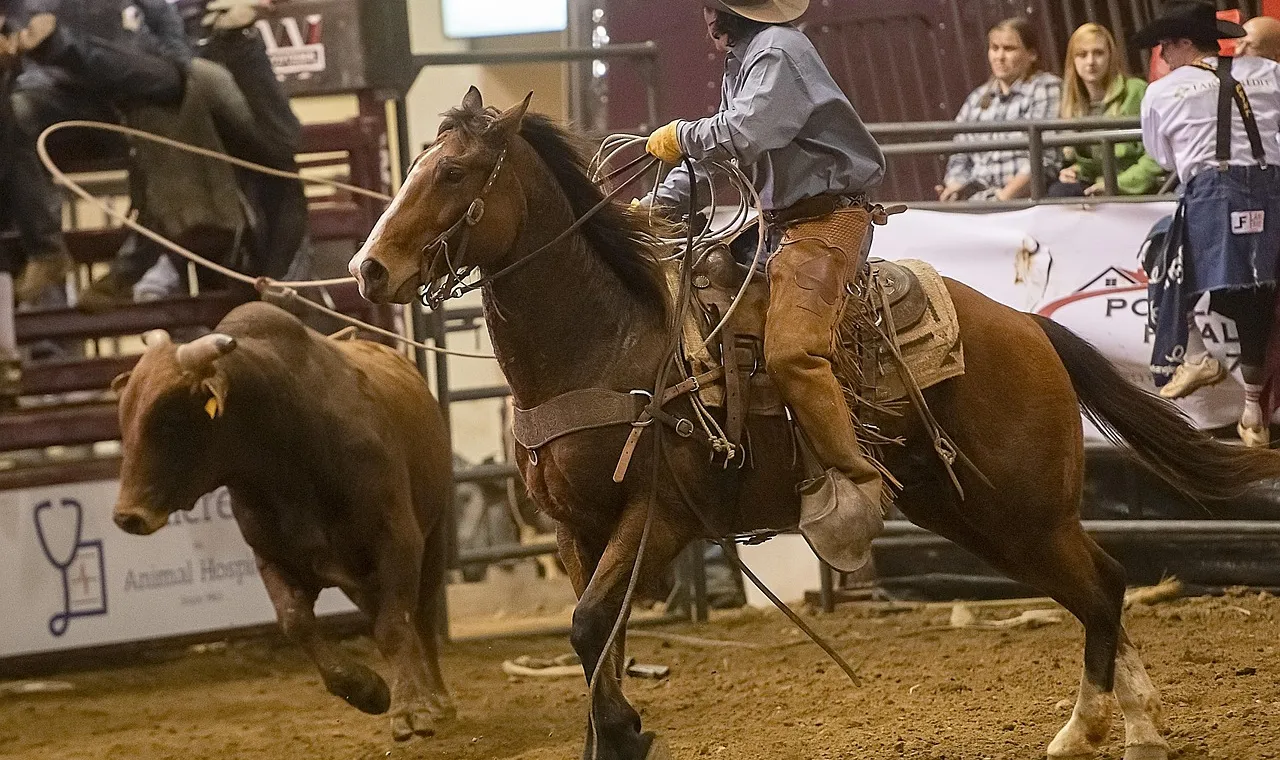
Team roping is the only western event where two riders are scored as one, and almost everything interesting about it is in the definitions rather than in the action.
The shape is simple enough to describe in a sentence. A steer is released from a chute. One rider, the header, ropes the front end. The other, the heeler, ropes the back legs. The clock stops when the animal is caught between them.
Then you read the rulebook and find out how much work the word “caught” is doing.
Three catches, and one eye
The World Series of Team Roping allows the header exactly three legal catches. Around both horns. Around the neck. Or half a head, which means the loop goes around one horn and the head, and one eye of the steer must look through the loop.
One eye. Through the loop. That is a rule written by people who have argued about a particular throw often enough to need a test that settles it from the fence.
If the header ropes any leg, the run is a no time. If the heeler catches a front foot it is a foul catch, though if the foot comes out before time is called, the run stands.
The clock is harder to stop than to start
Time is not taken when the second rope lands. It is taken when the steer is roped and secure between both partners, with both horses facing the steer, ropes dallied and tight, the horses’ front feet on the ground and both ropers mounted.
Every clause there is somebody’s disputed run. The horses have to face. The ropes have to be tight. Nobody can be halfway off. A team can make two clean throws and still be watching the clock run because one horse has not turned to look at the steer yet.
The head start is a physical object
The steer gets a head start, and it is enforced by a barrier: a length across the front of the header’s box, set between 32 and 36 inches high at the centre. Break out before the steer has had its start and you take five seconds.
Five seconds, in an event decided in single digits, is the run.
The rule that exists because of a son
A crossfire is when the heeler throws before the steer has finished changing direction behind the header. Timed perfectly, it is faster than doing it properly. It is also illegal.
The Team Roping Journal traces the ban to the early 1970s, and the detail I keep coming back to is who pushed it through. Dick Yates was the team roping director at the time and believed the rule was needed for the sake of solid horsemanship and fundamental roping skills. His own son was good at crossfiring.
Tommy Keith, a supervisor of professional officials for the PRCA, gives the working test: if the steer is pulled into the loop, the initial switch is complete; if he swings into the loop, and you see that initial switch start, it is a crossfire. Kirk Bray, president of the USTRC, points out that when the rule first went in there were no heel barriers at all.
So a sport that is decided in five or six seconds has a rule against a faster method, put there deliberately, because the faster method rewards timing over horsemanship. That is a choice, and somebody made it against their own family’s interest.
Why I like watching it
I have stood and watched roping, and what makes it worth watching is not the speed. It is that two people and two horses have to agree, at a gallop, about an animal that has its own plan.
The header’s horse has to leave hard, get position, and then turn the steer off — which means the horse is asked to accelerate and then immediately do something quite different while a rope comes tight. The heeler’s horse has to arrive in the right place at the right moment and then hold.
Four animals, one time on the board, and a rulebook that has decided exactly how many of the steer’s eyes need to be inside the rope.