Barrel racing
3 barrels, a clover-leaf, and a clock. No judge, no style marks, and a 5-second penalty that ends your day if you tip one.
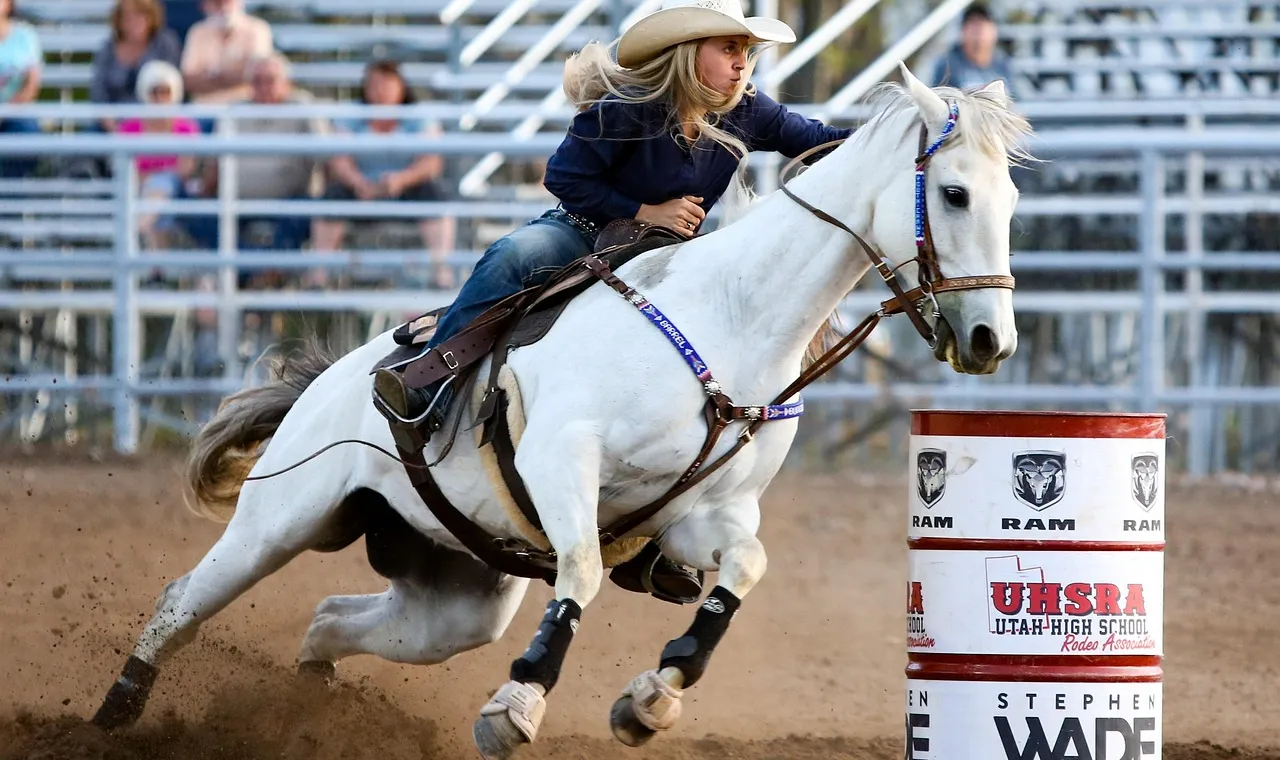
3 barrels, set in a clover-leaf. A horse comes in flat out, turns the first, crosses to the second, turns it the other way, runs to the third, turns, and comes home down the middle.
What gets you first is the size of everybody involved. Very small girls, on horses several hundred kilos heavier than them, going faster than seems sensible, leaning into a turn until their boot is somewhere near the sand. Then it is over and the next one comes in.
How long is a run
Longer than I thought, and the answer depends entirely on the arena.
A standard WPRA pattern is a 60-foot score line, 90 feet between the first and second barrels, and 105 feet from each of those to the third. On that, the fastest run ever recorded is 16.31, by Kathy Grimes on KG Just Money at the Cassia County Fair and Rodeo in Burley, Idaho. The entire top 5 sits between 16.31 and 16.49.
But the pattern at the National Finals Rodeo, in the Thomas and Mack Center, is much smaller, and winning runs there sit in the low 13s. Hailey Kinsel holds the arena record at 13.11.
The cleanest illustration is Kinsel herself. The 2020 finals at Globe Life Field is the only one ever run on a full standard pattern, and there she ran 16.56.
Same rider, same sport, 3 and a half seconds apart. Ask how fast a barrel run is and the honest answer is: how big is the arena.
Go looking for the rules and there is almost nothing there
This is the part that changed how I watch it.
Every other western class in this series has somebody with a scoresheet deciding what they saw. A cutting judge weighs courage. A ranch riding judge marks natural appearance out of a point and a half. A reining judge decides whether a movement counted as the horse’s own idea, and there is a whole vocabulary for arguing about it afterwards.
Open the barrel racing rules expecting the same and you find a clock. Riders are not judged on horsemanship, purely on how quickly they navigate the course.
That is it. No style marks. No hierarchy of correctness over quality over difficulty. No benefit of the doubt, because there is no doubt to have a benefit about. A number goes on the board and it is either lower than the others or it is not.
5 seconds
There is one penalty worth knowing and it is brutal.
Knock a barrel down and 5 seconds are added.
The top 5 standard-pattern runs of all time are separated by 0.18 of a second. A tipped barrel costs you 5. That is not a deduction, it is the end of your afternoon, and it puts you behind people who are not in the same conversation as you.
Which tells you exactly what the sport is. The whole skill is running as close to a barrel as you physically can without moving it, at a gallop, 3 times, on an animal changing direction underneath you each time. Every turn is a rider asking a horse to get closer than is comfortable, and one contact undoes all of it.
Watch a few runs with that in mind and the good ones stop looking fast and start looking tight.
It was built for women and it stayed that way
Barrel racing started informally in America in the 1930s and was formalised in the 1940s, and it was created as the rodeo event women were allowed to enter. At the top level it still is theirs alone, the only major western event with a championship closed to men.
So it arrived as the event women could do, and it was timed rather than judged. Which means nobody’s opinion has ever stood between a competitor and her result. Of all the ways to build a sport for people being kept out of the others, a stopwatch is a good one.
The horse knows the pattern
The thing I underrate every time is how much of this is the horse.
It has to accelerate flat out, decelerate into a turn, get its hind end underneath itself, rotate around something it is being asked to nearly touch, and leave again at full speed. 3 times, in a fixed order it has run hundreds of times before.
A 40-kilo child is not steering that. She is asking, and it is answering, and the asking has to be exactly on time or the turn comes a stride too early and the barrel goes over.
16 seconds, and most of the work happened months ago.