What a cutting rider actually does
The rider drops the rein hand and stops steering. That is not the same as stopping work, and the difference is most of what makes cutting hard to do well.
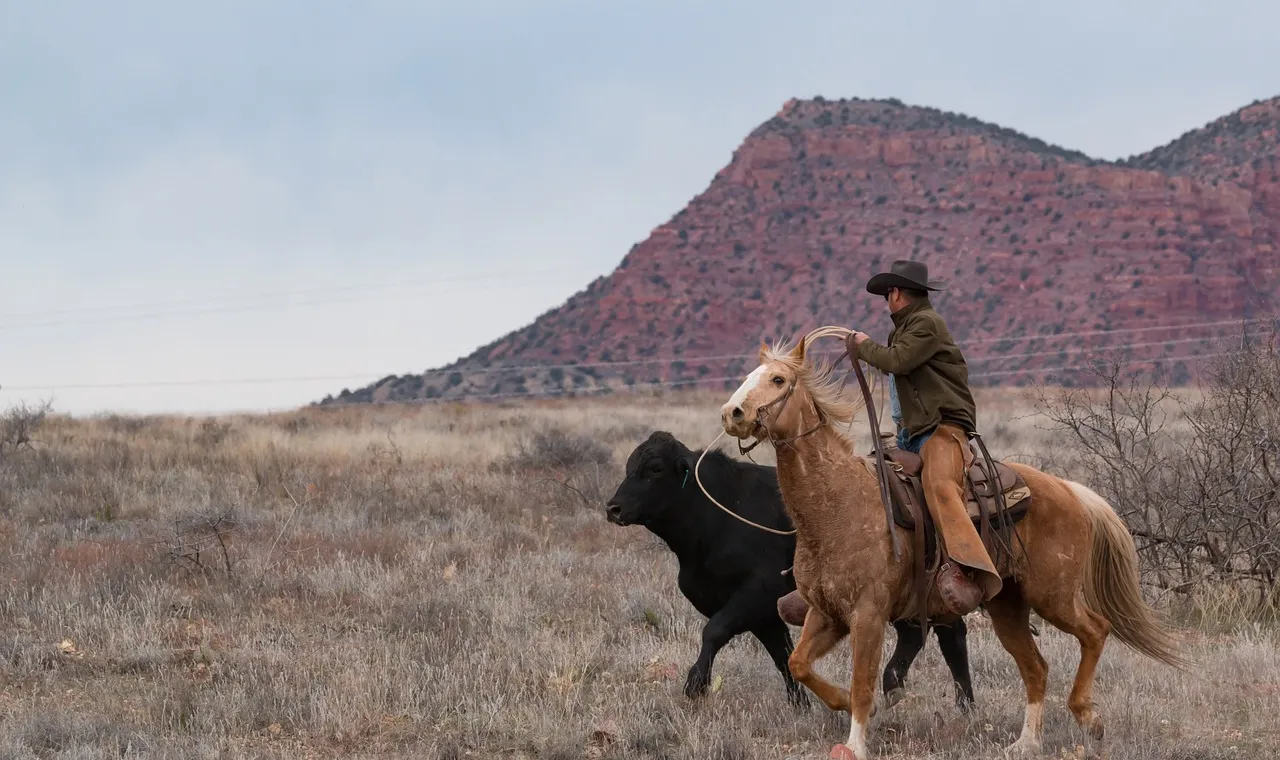
A cutting run lasts two and a half minutes. A rider takes a horse into a herd of cattle, moves one animal out into the open, and then drops the rein hand down onto the horse’s neck. From that point the horse is not being steered. Putting a second hand back on the reins is a penalty.
It is easy to look at that and conclude the rider has the easy half. I did. It is the wrong conclusion, and correcting it is the point of this post.
The rider’s job after the hand goes down
Nearly every general description of cutting says a version of the same sentence: the horse then works almost entirely on its own. Ariat’s explainer uses close to those words. It is accurate about the reins and it leaves out the rest.
The guidance Tri-State Livestock News carries from the American Quarter Horse Association describes something else entirely. Stay centred. One hand on the reins, the other on the saddle horn. Push off the horn rather than pulling yourself forward. Toes out, legs underneath you, feet never allowed to slide out in front. Stop the horse with your seat: heels down, leg pressure off, hips rocked back.
The saddle horn is a brace to push against, not a handle to haul on. A rider pulling themselves forward on it drags their weight over the horse’s shoulders at the moment the horse needs that weight behind them.
Larry Trocha, who trains cutting and reining horses, is specific about where the rider’s attention has to be. Timing and balance both come from watching the cow, he says, and a rider who looks down at the horse’s head has stopped knowing when the cow will turn. When the cow crosses the pen, stops and reverses, he calls it imperative that the rider sits down in the saddle to help the horse.
To help the horse. The rider’s body is part of the stop.
What the horse brings to the arrangement is called cow sense: reading the animal and moving before it has finished deciding to move. A horse with it does not look obedient. It looks like it has an opinion.
So what ends when the hand drops is steering, and only steering. What continues is a rider staying with an animal through violent lateral movement they did not initiate, without unbalancing it, for two and a half minutes, eyes locked on a cow the whole time. Two riders can sit the same horse and take different scores out of it. Watching from the rail, the better one looks like they are doing less.
Three years old
The horse is not doing it on instinct alone either, and the calendar makes that plain.
The NCHA Futurity is the biggest event in the sport, a Triple Crown fixture held in Fort Worth over close to four weeks, from 16 November to 12 December in 2026. It is for three-year-olds.
Three. A horse standing in that pen has been under saddle for something like two years, and in that time somebody has taught it to go quietly into a herd, choose an animal without scattering the rest, hold position against a cow that does not want to be held, and stop and turn hard enough to stay in front of it. Then that person hands the reins to whoever is riding and gets no score of their own.
The money follows the work. The NCHA added a million dollars to the 2023 Futurity purse alone, and its executive director Jay Winborn framed it as continuing to invest in the association’s events.
That release is also where the standing of one horse becomes unmissable. The event’s full name in the NCHA’s own announcement is the NCHA Metallic Cat World Championship Futurity. The sport’s championship for young horses carries the name of a stallion.
Metallic Cat
He is a red roan foaled in 2005, by High Brow Cat out of Chers Shadow. He won the NCHA Open Futurity in 2008 as a three-year-old and was NCHA Horse of the Year in 2009, ridden by Beau Galyean, and his own showing career brought in $637,711.
The larger number is what came after. The National Reined Cow Horse Association listed him as their all-time leading sire as of November 2023, with more than $4.25 million earned by his offspring in NRCHA competition alone. That counts one association’s events; his totals across cutting as a whole are considerably larger.
None of that is an accident of pedigree. Every one of those offspring was broken, taught and shown by somebody, most of them by people whose names are not on any results list a casual reader will ever see.
It was work before it was a sport
Cowboys separated cattle out of a herd because an animal needed branding or treating, and doing it on horseback without scattering several hundred others was simply the job. Ariat dates the first official competition to Haskell, Texas, in 1898.
The arena version keeps the herd and the cow and adds a clock and a judge. Four other riders work the pen throughout and none of them is scored: two turnback riders keep the cow from escaping to the back, two herd holders keep the remaining cattle bunched. Six horses working, one result.
What the judge rewards
Every horse starts at 70. The judge moves up or down and most runs land between 60 and 80. Four things earn credit according to the National Cutting Horse Association: the horse’s demeanour in the herd, how well it controls the cow, the degree of difficulty the cow presents, and courage.
The third one is unusual and worth stating plainly. A horse is credited for how hard its cow tested it. Nobody chooses their cow, so a placid animal that gives up after two steps scores lower than a determined one that tries everything, even where both runs end with the cow contained. The sport has decided to say out loud that the draw matters, rather than pretend it away.
Losing a cow costs points, and so does a horse quitting one the rider did not ask it to quit. There is one more rule I would keep if I could keep only one: where a penalty is borderline, or the judge is not certain it happened, the benefit of the doubt goes to the cutter. That is a rulebook admitting that a judge two seconds behind a cow is sometimes guessing.
Two and a half minutes. Six horses in the pen and one score on the board. Everything that makes a good run look like nothing much was put there by somebody over about two years, and there is no column on the scoresheet for them.